
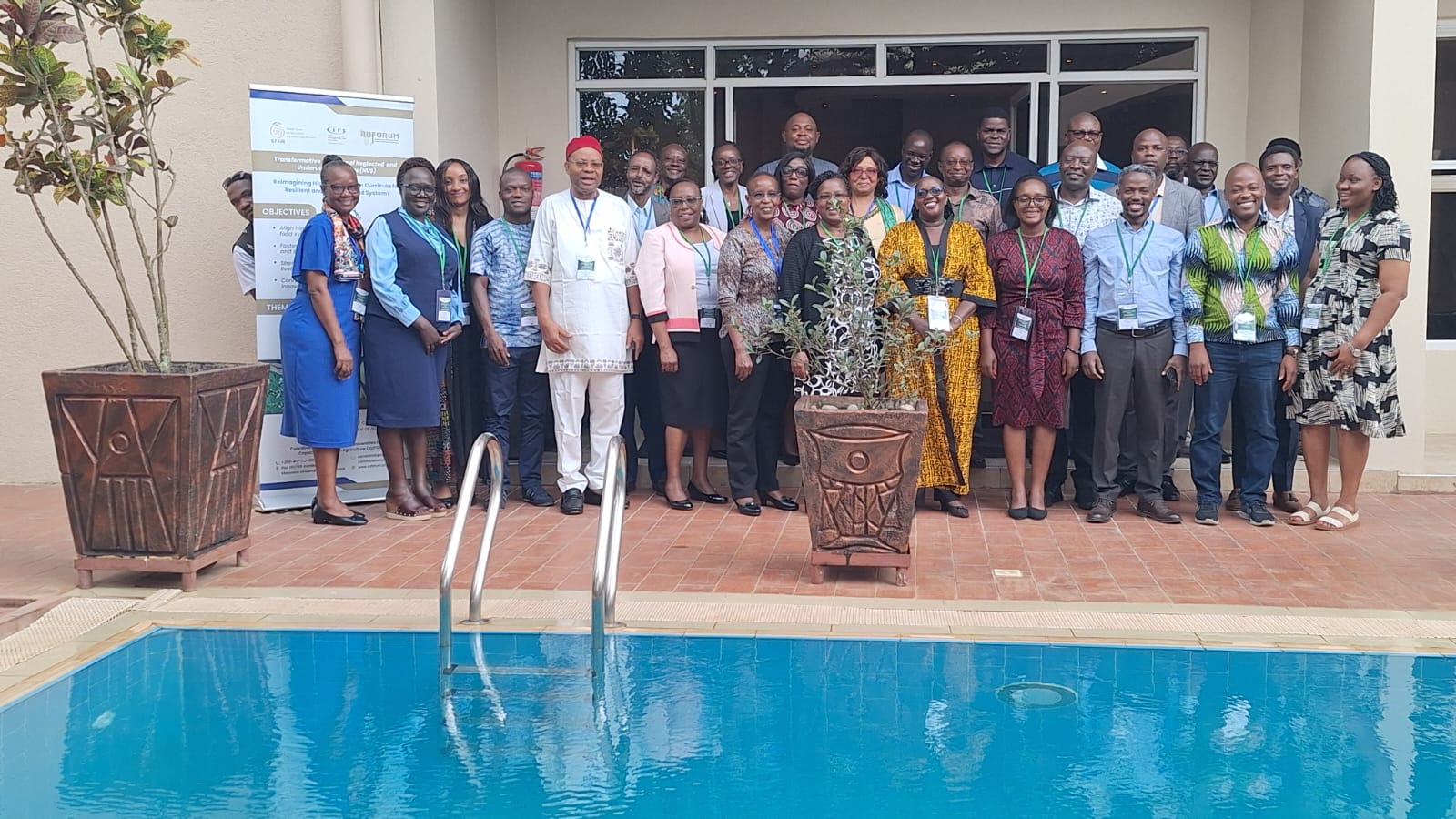
15 – 17 July 2026. Entebbe, Uganda
The NUS Open-Source Curriculum Network Africa team convened for a workshop organised by the Regional Universities Forum for Capacity Building in Agriculture (RUFORUM), in partnership with the Global Forum on Agricultural Innovation and Research (GFAiR) and the Alliance of Bioversity International and CIAT.
The three‑day workshop, titled “Advancing Neglected and Underutilised Species (NUS) Education Across Africa,” brought together curriculum block leads and contributors from RUFORUM partner universities across the continent to transform the competency‑based NUS curriculum into a complete set of high‑quality, open‑source digital learning resources that can be delivered asynchronously by universities across Africa.
Participants worked collaboratively to develop standardised course assets, including course overviews, lesson notes, multimedia resources, readings, assignments, knowledge checks, and to document remaining curriculum gaps.
Aligning NUS curriculum with market needs
The workshop followed a structured Curriculum Asset Completion Process (CACP) built around seven registers that guided participants from curriculum mapping to final handover. Emphasis was placed on ensuring that the curriculum aligns with labour market needs, competency‑based education principles, and quality standards for online learning.
By the end of the workshop, participating universities completed and peer‑reviewed the core digital assets required to build an open‑access Bachelor's and Master's curriculum on Neglected and Underutilised Species, supporting wider adoption of NUS education across the RUFORUM network and beyond.
Workshop leadership
- Dr. Florence Nakayiwa – Opening and closing remarks; overall workshop leadership
- Dr. Mary Kulabako – Participant introductions and team assignments
- Dr. Peter Kigwilu – Workshop flow, roles and expectations; Curriculum Asset Completion Process (CACP); online lesson note development; daily debriefs; curriculum finalisation; formal handover of curriculum assets
- Emmanuel Okalany – Aligning the NUS curriculum with labour market needs and employability
- Dr. Bernadette Kiarie – Developing quality course assets for asynchronous learning; competency‑based online pedagogy; assessment design; workshop coordination; post‑workshop action planning
- Block Leads with Subject Matter Expert (SME) Teams – Review of course mapping, competencies and learning outcomes; validation of modules; development of course assets
- Block Teams and Instructional Designers (IDs) – Preparation of course overviews, reading lists, multimedia resources, lesson notes, assignments and knowledge checks
- Lead SMEs – Team presentations showcasing completed curriculum assets, identifying remaining gaps, and signing off curriculum packages
Next Steps
- August: Final technical validation and revision of modules
- September: Finalisation of validated open‑source curriculum materials and pilot implementation plan; lecturer training and pilot launch across participating universities
- October: Full pilot report and lessons learned; final dissemination materials and upload of the finished curriculum; Africa launch webinar and consolidation of results for global synthesis and reporting