Future-proofing EU Agri-Food through research and innovation
25 September 2026, Brussels
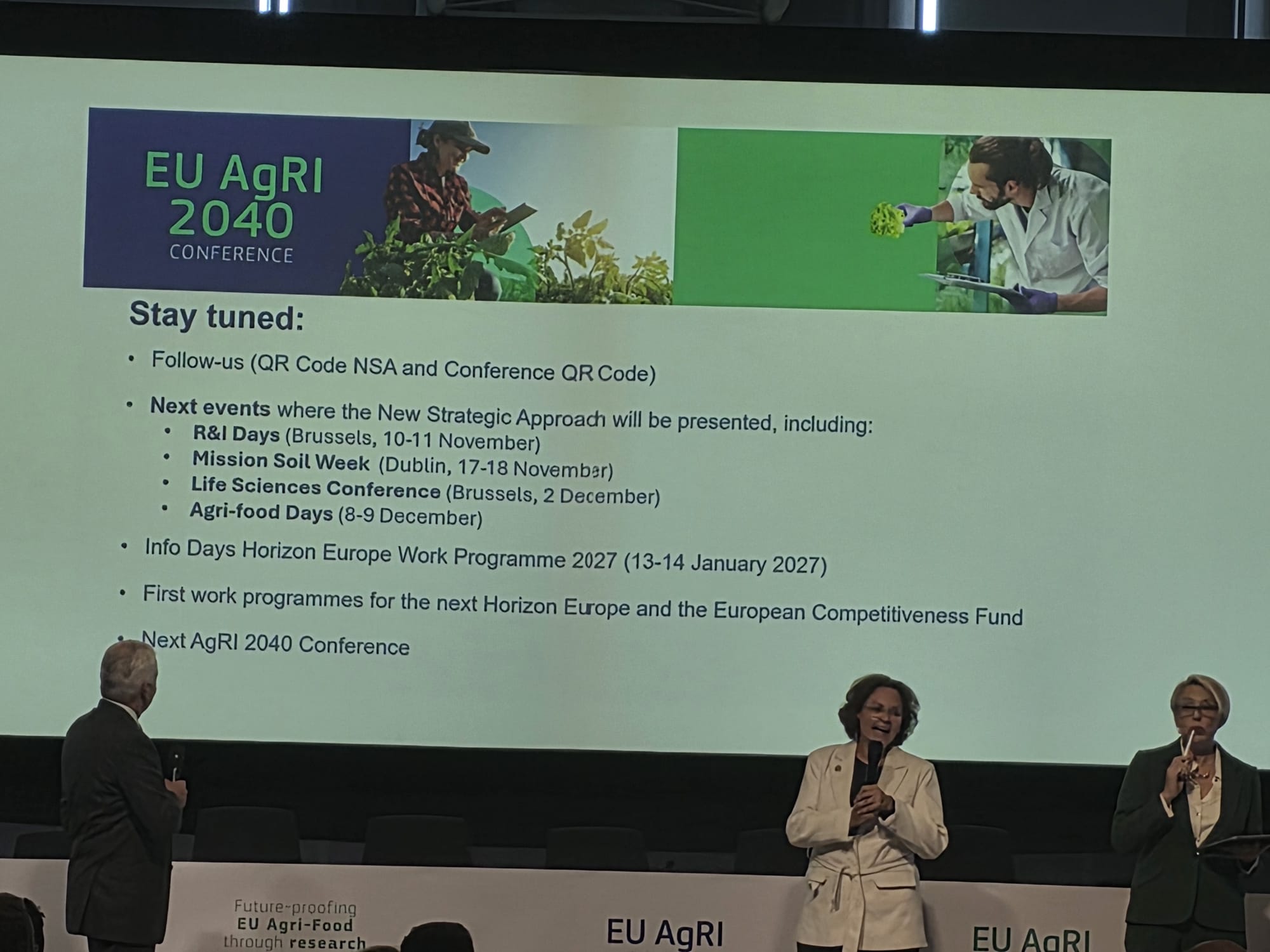
At the EU AgRI 2040 Conference, held under the theme "Future-proofing EU Agri-Food through research and innovation," a panel on "Partnerships for research and innovation that foster competitive, resilient and sustainable agrifood systems in Europe and beyond" explored how strategic research and innovation partnerships — both within Europe and internationally — can move beyond individual projects to deliver innovation at scale.
The discussion brought together perspectives from FAO, CGIAR, the European Investment Bank, the Bio-based Industries Consortium, the Horizon Europe Agroecology Partnership, Novo Nordisk and Tereos, reflecting the need to connect public research, international organisations, finance and private-sector innovation.
A central message was that successful partnerships need to link research much more closely with deployment, investment and end users. Scientific knowledge alone is insufficient: farmers, businesses and other users need to participate in defining problems, co-creating and testing solutions, while financial institutions and companies can help move promising innovations from demonstration to commercial scale.
This corresponds closely to the Commission's new AgRI 2040/Food 2040 approach, which puts greater emphasis on multi-actor approaches, real-world testing, market uptake, startups and SMEs.
The panel also illustrated several complementary partnership models.
Charles Spillane (FAO) and Anna Okello (CGIAR) brought the international and research-system perspective; Jean François de Saedeleer (EIB) represented the financing dimension; Katariina Kemppainen (Bio-based Industries Consortium) highlighted public-private collaboration and the bioeconomy; Ulrike Ziegler (Horizon Europe Agroecology Partnership) represented long-term transnational research programming.
Mette Damgaard Nielsen (Novo Nordisk) and Valérie Corre (Tereos) brought private-sector perspectives. Together, these examples pointed toward partnerships that combine research capacity, public-interest objectives, private innovation and investment, rather than treating them as separate domains.
Importantly, the discussion extended “beyond Europe.” International cooperation is one of the six cross-cutting priorities of the new EU strategic approach, alongside competitiveness, food security and resilience, natural resources and circularity, health and nutrition, and fairness. The implication is that future EU partnerships should increasingly be based on joint priority-setting and mutually beneficial collaboration with international partners, connecting European R&I capabilities with locally defined needs and innovation systems rather than simply transferring European technologies.
The Global Forum on Agricultural Research and Innovation (GFAiR) recommended that for the next edition of Food 2040, DG RTD — the European Commission's Directorate-General for Research and Innovation — organise a panel with representatives of strong National Agricultural Research Organisations, such as EMBRAPA — the Brazilian Agricultural Research Corporation (Empresa Brasileira de Pesquisa Agropecuária), CAAS — the Chinese Academy of Agricultural Sciences, ICAR — the Indian Council of Agricultural Research, and KALRO — the Kenya Agricultural and Livestock Research Organization.
"Specific research for temperate zones and tropical zones is getting increasingly blurred. We are sharing the same problems and need to work together on solutions."
The two-day event, was a chance to connect with key stakeholders and help shape the priorities of the next Horizon Europe EU Research and Innovation Framework Programme and the future European Competitiveness Fund.
Day 1 explored how research and innovation can support more competitive, resilient and sustainable agriculture, forestry and rural areas.
Day 2 built on these exchanges to consider how strategic research and innovation partnerships can be strengthened within the EU and beyond.