
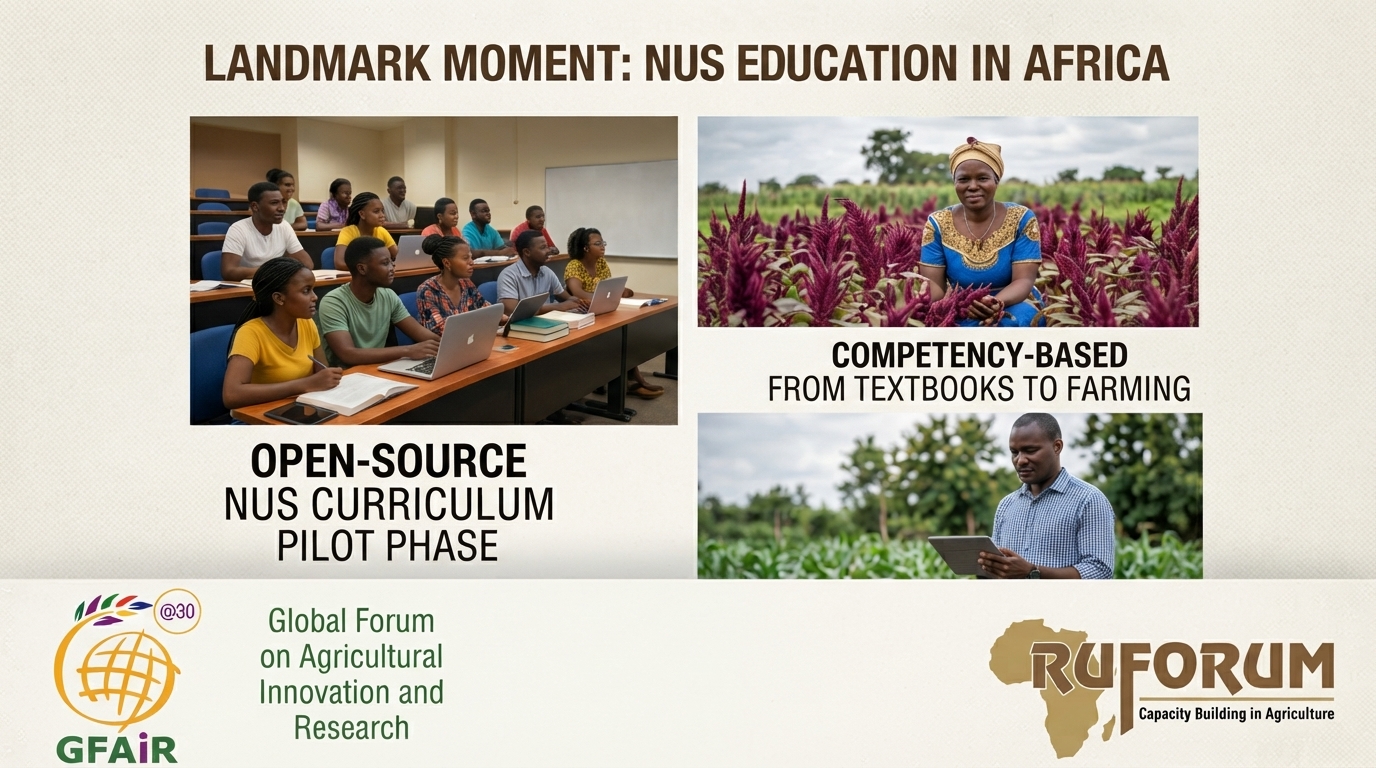
September 28, 2026 — A landmark open-source curriculum on Neglected and Underutilised Species (NUS) is set to begin its pilot phase, with 14 African universities in nine countries invited to pretest the courses. About 535 students will take part in the exercise between 5 October and 31 October 2026.
Supported by the Global Forum on Agricultural Innovation and Research (GFAiR) and spearheaded by the Regional Universities Forum for Capacity Building in Agriculture (RUFORUM), it is the first NUS curriculum of its kind to be co-developed at this scale.
The curriculum was developed by university and global experts. It uses NUS as the main examples across production, environment, health, consumption, innovation, trade and technology, and prepares graduates to build careers and enterprises around these crops.
Free, open and flexible
The curriculum is free and open, hosted on the RUFORUM e-learning platform. It is delivered as standalone short courses — fully self-paced, online and asynchronous, each with its own certificate. Universities can offer the courses as standalone credentials, embed them in existing programmes, or use them as supplementary reading.
Why now
In the 2026 baseline survey of 57 institutions in 25 countries, only about one third had a dedicated NUS course. Yet 84% wanted to co-develop open NUS modules, and 74% were willing to pilot in September 2026. The curriculum responds directly to that demand — and because it is free and open, any university can adopt it without cost barriers. It is also competency-based, with entrepreneurship and 21st century skills built into every block.
Impact on farming
The pathway the project is aiming for:
- Lecturers adopt the courses, and students learn about climate-resilient, nutrient-dense crops.
- Students apply what they learn through university extension projects, field trials and farmer training sessions.
- Graduates work with smallholder farmers as extension agents, agronomists and advisors, and bring practical ways of growing neglected crops to the farm.
The aim is to move NUS research out of textbooks and into everyday farming.
Seven knowledge blocks
The curriculum spans seven blocks: Foundations and Systems; Production and Agronomy; Post-Harvest and Processing; Business Development; Nutrition and Health; Climate and Biodiversity; and Policy and Food Systems. Technical skills, 21st century skills and entrepreneurship are built in across all blocks.
Target audience
- Learners — Undergraduate, Masters and PhD students and graduate teaching assistants, especially in agriculture, food, nutrition, environment and agribusiness programmes.
- Lecturers and researchers — They adopt, adapt and popularise the courses, and can use them as reference material.
- Beyond universities — Open to any interested institution, student or extension worker, including those outside the network.
Piloting
The pilot is a pretest of the courses with students, not a full taught semester. Students work through courses online on their own, then give feedback. That feedback shapes the final versions and feeds the project report.
- Window. 5 October and 31 October 2026. Courses are released on a rolling basis as each is completed.
- Staggered start. Institutions that are ready begin on 28 September. Others start in the first weeks of October as offline PDF versions become available, with start dates agreed with each institution.
- Registration. Students register on the RUFORUM e-learning platform (university, age and gender are captured for reporting).
- Completion. Students receive a certificate and are sent to a short post-course survey.
Partners
The curriculum was built by subject matter experts from 14 African universities in nine countries, working with global partners including ICRISAT, Welthungerhilfe, University of Southampton, Humboldt-Universität zu Berlin (SLE), Buckinghamshire New University, Odisha University of Agriculture and Technology, IFPRI and the Biocultural Education and Research Programme.
Eleven universities have shared their pilot plans so far, covering about 535 students.
What's next
Feedback from the pilot will be used to refine the courses ahead of the open-source curriculum's launch in November 2026. Date and venue are to be confirmed. The Community of Practice will continue beyond 2026, with the certification approach refined and longer-term learning pathways explored.
The Global Forum on Agricultural Innovation and Research (GFAiR) is supported by the European Commission.