November 16, 2026 | Nairobi, Kenya
A landmark open-source curriculum on Neglected and Underutilised Species (NUS) was launched today, marking a historic milestone for global agricultural education. This is the first time an open-source, competency-based curriculum on Forgotten Foods is available globally, with nearly 400 learners from 38 countries already having tested it.
The launch took place during a webinar attended by almost 30 partners, including contributors, partner universities, the Regional Universities Forum for Capacity Building in Agriculture (RUFORUM), and the learners who piloted the curriculum.
Speaking during the launch, GFAiR Executive Secretary Joanna Kane-Potaka said she was inspired and excited by what has been created.
She noted that the curriculum was co-designed as one of GFAiR’s Collective Actions, which bring organisations together to achieve what none can alone. RUFORUM took the lead and brought people together from around the globe: 42 contributors from 26 countries across seven courses.
She highlighted the unique content of the curriculum.
"NUS, once called smart foods, are good for people, the planet and the farmer. They are good for the farmer only if markets and value chains are developed, and behind that is the research and knowledge these courses provide to take NUS to the next level."
She also pointed out that the seven courses are competency-based and quality assured, with each including entrepreneurship skills that engage young people and other actors.
Ms Kane-Potaka thanked RUFORUM for leading the process, hosting the curriculum on their e-platform, and co-convening the network. She also thanked the European Commission for funding, with International Fund for Agricultural Development (IFAD) coordinating on its behalf, and the International Foundation for Science (IFS).
"This is just the beginning," she said, appealing to partners and funders to support the next phase. She congratulated all contributors for their work and dedication and officially launched the NUS Open-Source Curriculum as available globally.
Initiative Background and Curriculum Reach
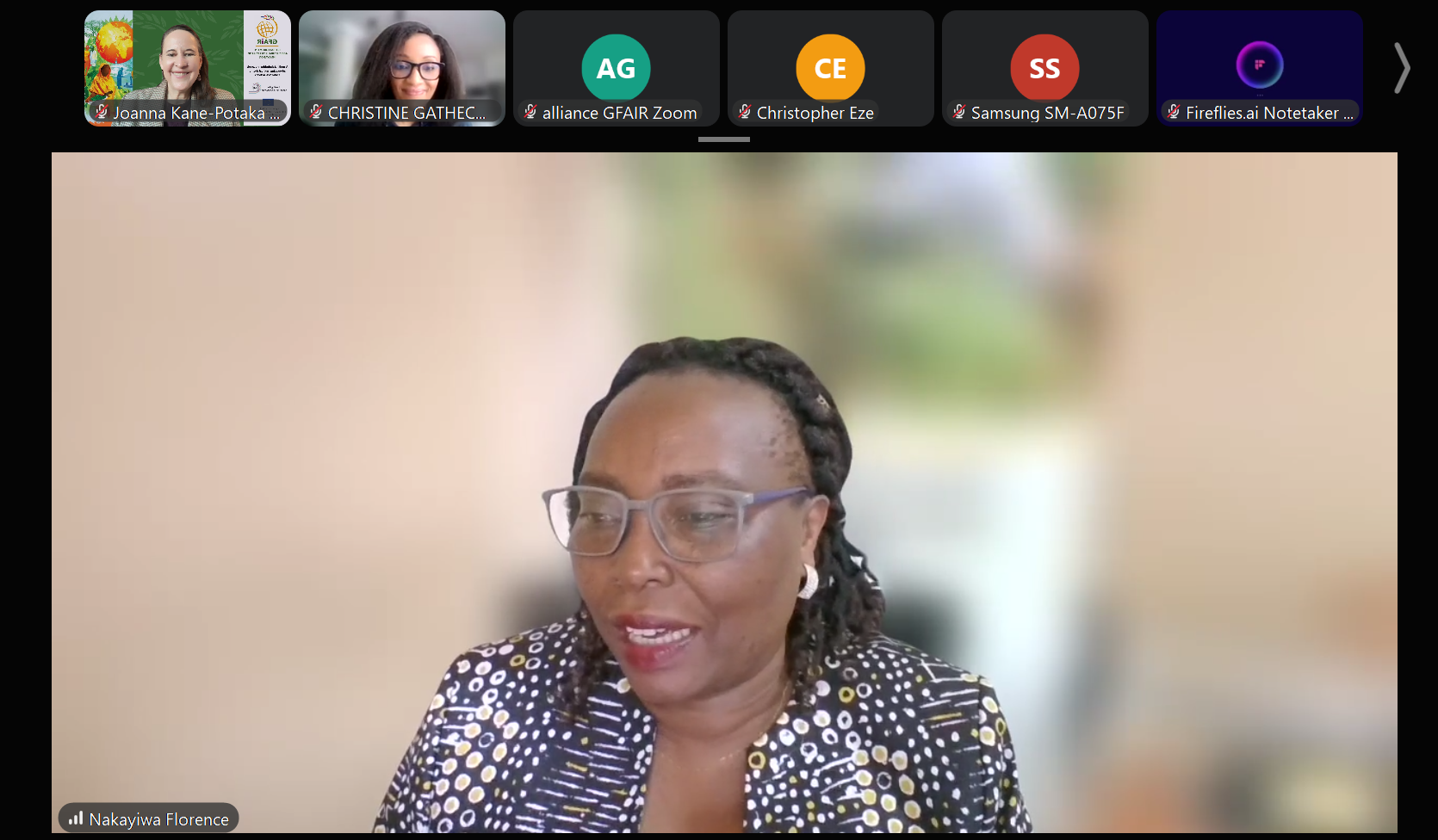
RUFORUM Deputy Executive Secretary, Dr. Florence Mayega Nakayiwa, reflected that when the process began close to a year ago, few would have expected to be here. She commended the universities that shaped the process, noting that finishing in just under a year is no small feat.
"Not many institutions had an NUS curriculum at the start, but those that did gave it their own. More than 40 contributors from over 26 countries, both within and beyond Africa, took part, which makes this a truly global initiative," Dr. Nakayiwa stated.
She described the curriculum as the start of a movement, noting that the platform is open, can host more courses, and that all seven courses have been piloted and are ready for adoption.
Curriculum Development and Collaboration
Egerton University lecturer Dr. Mary Waiganjo reflected on the development process, detailing the cross-country team behind her curriculum block and the progression from broad goals to modules, lessons, learning materials, and assessments. She described the work of aligning terminology, centering the learner journey, and maintaining shared understanding through document coordination.
Dr. Waiganjo spoke about the journey since December last year, from early design conversations through the development of Block 0 (Foundations & Systems) to the pilot. Block 0 was led from Uganda by Prof. Peter Baguma alongside Mary, joined by Prof. Arinola Adefila in the UK and Prof. Anshuman Das in India.
Working across the UK, India, Kenya, and Uganda was rewarding but not always smooth. The block began with a broad ambition and became more concrete, ending up with four modules and 25 lessons. Dr. Waiganjo thanked the instructional designer for their patience, noting that the team learned the language of lesson plans and aligned terminology to ensure lessons built on one another.
She emphasised that digital platforms make collaboration possible but cannot by themselves create a shared understanding. Agreed templates, clear responsibilities, version control, and regular check-ins are essential.
University Endorsements and Regional Adoption
Prof. Christopher Eze, Vice Chancellor of the University of Agriculture and Environmental Sciences (UAES) in Nigeria, said he joined the network after a conference in Germany in June 2025, where he was introduced to Dr. Maureen Duru, who connected him to RUFORUM and GFAiR.
UAES has a policy on neglected plants and natural food trees, which aligns with what NUS stands for, and includes endangered crops in its agroecology and food systems programme supported by the EU. Prof. Eze announced that UAES will adopt most of this open-access curriculum and serve as an anchor to expand it in West Africa among young people and farmers.
"These crops have sustained life from the beginning. People can build businesses around the value chain, packaging and food preparation, and the environment will benefit as well as farmers," said Prof. Eze.
He congratulated RUFORUM and GFAiR for initiating the process.
Nutrition, Practical Learning, and Student Uptake
Dr. Francis Padi Lamptey of Cape Coast Technical University, Ghana, spoke on behalf of his Vice Chancellor, emphasising that universities must respond to food security, nutrition, climate change, and youth unemployment. He noted that while Africa has a rich diversity of indigenous crops, many remain underutilised despite their potential.
Dr. Lamptey, who led Block 4 (Nutrition & Health), valued working with colleagues across Africa, including Prof. Gloria Essilfie of the University of Ghana. He noted that the curriculum supports practical development, allowing students to explore food processing, value addition, and agribusiness—turning an under-used indigenous crop into the raw material for flour, beverages, and snacks.
At Cape Coast Technical University, students will complete the NUS course online and show the certificate before they graduate. He encouraged other African universities to take advantage of the initiative.
Access the Curriculum
The NUS Open-Source Curriculum is now available globally. Whether you are a student, lecturer, researcher, or extension worker, you can access the courses and begin learning today.
To access the platform, please click here —–> RUFORUM e-learning platform.
For access issues, please contact: Unity Chipunza, u.chipunza@ruforum.org