
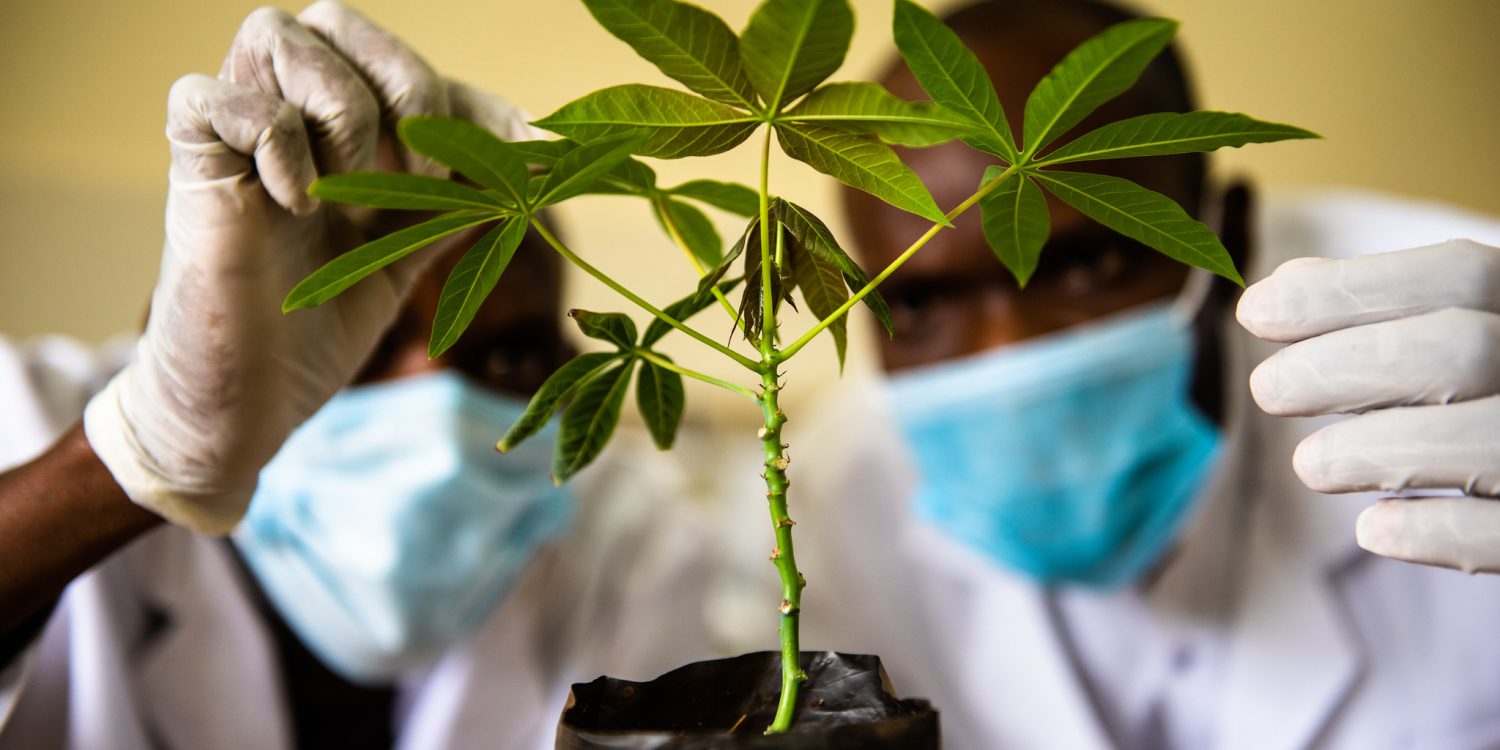
Everything you need to know about the ongoing Open-Source NUS Curriculum Pilot
October 5, 2026
1. What the NUS Curriculum is
An open-source, competency-based curriculum on Neglected and Underutilized Species (NUS), developed by university and global experts. It uses NUS as the main examples across production, environment, health, consumption, innovation, trade and technology.
Graduates learn what these crops offer and how to build careers and enterprises around them.
- Free and open. Hosted on the RUFORUM e-learning platform.
- Standalone short courses. Fully self-paced, online and asynchronous. Courses are independent and not sequenced, and each has its own certificate.
- Flexible adoption. Universities can offer the courses as standalone credentials, embed them in existing programmes, or use them as supplementary reading. Each institution decides through its own curriculum processes.
- Built by experts. Subject matter experts from African universities, working with global partners and instructional designers.
Why now
In the 2026 baseline survey of 57 institutions in 25 countries, only about one third had a dedicated NUS course. Yet 84% wanted to co-develop open NUS modules, and 74% were willing to pilot in September 2026.
What makes it different
- Open and free, so any university can use it.
- Built together by African universities and global partners, not by one institution.
- Competency-based, with entrepreneurship and 21st century skills in every block.
- Flexible enough to run as a standalone course, sit inside a programme, or serve as reading.
Impact on farming
This is the pathway we are aiming for.
- Lecturers adopt the courses, and students learn about climate-resilient, nutrient-dense crops.
- Students apply what they learn through university extension projects, field trials and farmer training sessions.
- Graduates work with smallholder farmers as extension agents, agronomists and advisors, and bring practical ways of growing neglected crops to the farm.
The aim is to move NUS research out of textbooks and into everyday farming.
2. Scope (seven knowledge blocks)
Each block is a set of courses built around defined competencies, learning outcomes, lessons, readings, activities and assessments.
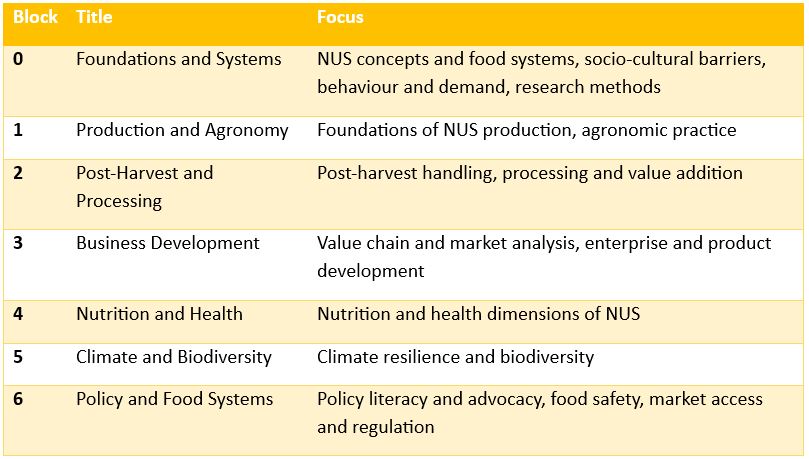
Built in across all blocks. Technical skills, 21st century skills (critical thinking, communication, problem-solving) and entrepreneurship. Each lesson has an introduction, body, summary and reflection. Courses include knowledge checks, module assessments and a course assessment.
3. Target audience
- Learners – Undergraduate, Masters and PhD students and graduate teaching assistants, especially in agriculture, food, nutrition, environment and agribusiness programmes.
- Lecturers and researchers – They adopt, adapt and popularise the courses, and can use them as reference material.
- Beyond universities – Open to any interested institution, student or extension worker, including those outside the network.
4. Piloting
The pilot is a pretest of the courses with students, not a full taught semester. Students work through courses online on their own, then give feedback. That feedback shapes the final versions and feeds the project report.
- 05 to 31 October 2026.
- Students register on the RUFORUM e-learning platform (university, age and gender are captured for reporting).
- Students receive a certificate of completion and are sent to a short post-course survey.
Pilot partners
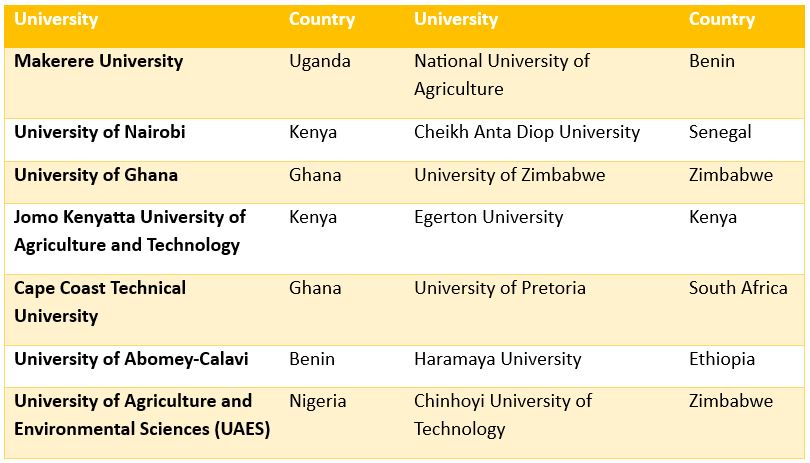
The curriculum was built by subject matter experts from 14 RUFORUM Partner universities in nine countries, working with global partners. All 14 are invited to pilot the courses, and 11 have shared their plans so far, covering about 535 students. Thank you to every team.
Global partners. ICRISAT, the Biocultural Education and Research Programme, Welthungerhilfe, University of Southampton, Humboldt-Universität zu Berlin (Centre for Rural Development, SLE), Buckinghamshire New University, Odisha University of Agriculture and Technology (OUAT), Dedan Kimathi University of Technology, Nnamdi Azikiwe University and IFPRI
5. Role of universities
- Name an institutional lead and confirm your cohort size and start date.
- Identify and mobilise students from existing programmes, including RUFORUM-affiliated scholars, graduate teaching assistants and PhD students.
- Support participation by encouraging registration, course completion and feedback.
- Confirm the certificate signatory and any internal approvals needed.
- Champion the curriculum internally. Brief Vice Chancellors, Deans and Heads of Department, and consider embedding modules through your own curriculum approval process.
- Join the Community of Practice and share lessons from your pilot.
What RUFORUM provides. The hosting platform, registration and orientation support, and technical help on request, including offline PDF versions for low-bandwidth students.
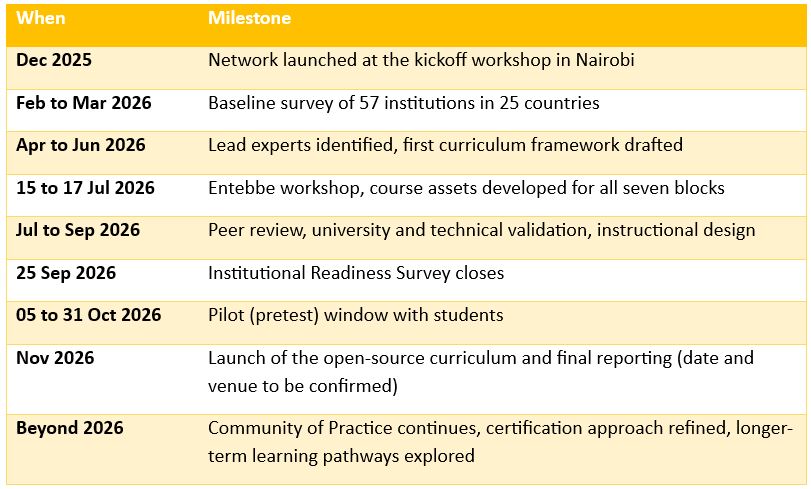
- Timelines
For questions or to get involved contact Christine Gathecha on christine.gathecha@gfair.network
To Access the Platform please click here—–> RUFORUM e-learning platform
Endorsed by
Florence Nakayiwa, Deputy Executive Secretary, RUFORUM
and
Joanna Kane-Potaka, Executive Secretary, GFAiR