“Who decides what Eastern Africa farmers grow?” Webinar tackles the hard questions
20 August 2026
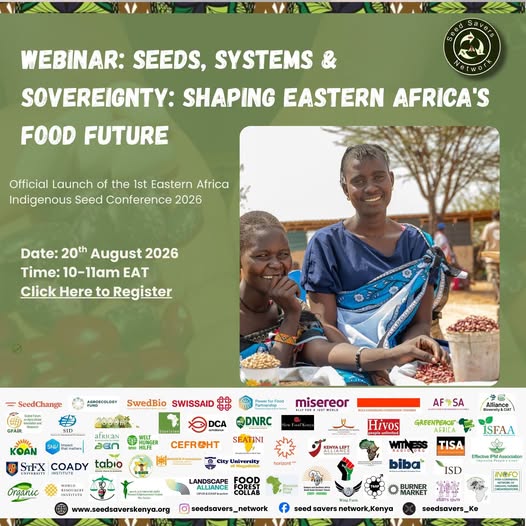
“Who decides what Eastern Africa farmers grow?” That provocative question was at the heart of the online webinar that marked the official launch of the 1st Eastern Africa Indigenous Seed Conference 2026 – hosted by Seed Savers Kenya.
Farmers, researchers, civil society organisations, food-system advocates, and agricultural stakeholders gathered to explore a future in which seeds are recognised not as mere commodities, but as living heritage – carrying knowledge, culture, and generations of resilience.
The webinar titled “Seeds, Systems & Sovereignty: Shaping Eastern Africa’s Food Future” placed seeds at the centre of a much larger discussion about food sovereignty, biodiversity, farmer rights, and the resilience of Eastern Africa's food systems.
More Than Just Seeds
Seeds are often discussed as one of many inputs farmers need to produce food. But indigenous and locally adapted varieties carry something far deeper: knowledge, culture, biodiversity, and generations of farmer experience.
Farmers have traditionally selected, saved, exchanged, and adapted seeds to suit their local environments. These practices help maintain crop diversity and preserve varieties adapted to specific climates, soils, diets, and cultural traditions. That makes seed systems an essential part of the region's food future.
The webinar encouraged participants to look beyond whether farmers have access to seed – and consider a deeper question:
"Who controls the seed system, and who gets to decide what farmers grow?"
The Challenge: Supporting What Works
Community seed banks have proven time and again that they are vital for protecting agrobiodiversity and strengthening seed security across Eastern Africa. Yet despite their demonstrated value, they face persistent challenges that make it difficult for them to thrive.
One significant obstacle is the mismatch between how community seed banks operate and how donor funding is structured. These seed banks are typically small, locally governed, and heavily reliant on volunteer effort. They require long-term, flexible support to grow and adapt – yet most funders favour short-term projects with clearly measurable commercial or technological outputs.
At the same time, restrictive seed regulations across the region often fail to recognise indigenous varieties, making it difficult for farmers to legally exchange, sell, or even preserve their own seeds. Weak integration into formal agricultural markets and limited access to finance further marginalise community-led initiatives.
Taken together, these factors make community seed banks appear difficult to scale – even though evidence clearly shows they are essential for maintaining crop diversity, strengthening food sovereignty, and building long-term climate resilience. The challenge is not whether these seed banks work – they do. The real question is whether the systems that surround them can evolve to offer the sustained, patient support they urgently need.
Farmer-Led Innovation: The PROLINNOVA Approach
Farmer-led research on indigenous seeds is key to building a more equitable food system.
PROLINNOVA (PROmoting Local INNOVAtion) is a global, NGO-initiated network and community of practice that promotes farmer-led innovation in ecologically oriented agriculture and natural resource management.
The network emerged in the early 2000s, with support from GFAR (then the Global Forum on Agricultural Research), which helped establish it as a Global Partnership Programme. It later became a recognised GFAR/GFAiR Collective Action. Through partnerships between farmers, researchers, NGOs, and development actors, PROLINNOVA puts farmers at the centre of research and decision-making – a principle that resonated throughout the webinar.
The November Conference: What to Expect
The webinar was more than a discussion about seeds – it was a conversation about who shapes Eastern Africa's agricultural future. The timing is significant. The launch of the 1st Eastern Africa Indigenous Seed Conference 2026 creates a broader platform for farmers, researchers, and advocates to continue exploring these critical questions.
Dates: 17–20 November 2026
Venue: Catholic University of Eastern Africa (CUEA), Nairobi, Kenya
What's on the agenda?
- Showcase farmer innovations and indigenous seed practices
- Document and share community seed bank experiences
- Advance conversations around seed sovereignty across the region
- Build networks between farmers, researchers, policymakers, and advocates
Whether you are a farmer, researcher, activist, or policymaker – this conference is a space to learn, share, and shape the future of food in Eastern Africa.
Call to Action
Be part of the movement.
Secure your place at Eastern Africa's first-ever gathering dedicated to indigenous seeds and food sovereignty.
Register here.