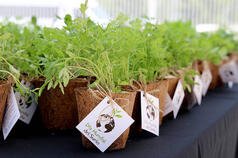

The Nepalese agriculture system is mostly characterized by low level of investment and income with subsistence economy. Lands are increasingly fallowed and youth are out migrating from rural villages to Middle East and are earning less than US$ 200 a month. However, there is a small but growing number of progressive youths and professionals have come up with agri-entrepreneurship as their profession. 

GFAR themes 2013

Last week on the occasion of the Committee on World Food Security and to mark the launch of the UN Decade of Action on Nutrition, FAO released a new eLearning module, Improving Nutrition through Agriculture and Food Systems, designed to assist professionals from any fields related to agriculture and food systems that are involved in designing and implementing nutrition-sensitive policies and investments.

We are pleased to send you the October issue of the GFAR Update!

The 2016 Partners’ Assembly of the Global Forum on Agricultural Research (GFAR) has decided to create a new Steering Committee for GFAR, one that is representative of all sectors, and which truly reflects the diversity of stakeholders in agricultural research and innovation around the world.

Nairobi based Access Agriculture has won GOLD in the Innovation category of the EVCOM Clarion Awards at an International Award Ceremony in London. The Access Agriculture website which features “farmer to farmer” videos in local languages was singled out for the imaginative way in which videos of value can be accessed by the target audience either directly or through extension staff.

Access Agriculture also received a highly recommended award in the video category.

GFAR themes 2013

Independent Evaluation Arrangement (IEA) of CGIAR launches Thematic Evaluation of Gender in CGIAR Research and in the CGIAR workplace

Online Survey for GAP Members on the relevance, dissemination, and use of CGIAR gender research

CGIAR has a long history of research on gender in agricultural research and development. Gender is also central to its four strategic objectives of reducing poverty, improving food security, improving nutrition and health, and working towards sustainable, resilient agroecosystems. 

Background
The Sustainable Agriculture Initiative Platform (SAI Platform) was established in 2002 by the food industry to support the development of sustainable agriculture worldwide. It has over 80 members across the value chain, covers all major agricultural commodities and operates globally. SAI Platform operates on a pre-competitive and non-commercial basis. It is overseen by an Executive Committee and run by a Secretariat of eight people working from various locations in Europe.

Subscribe to