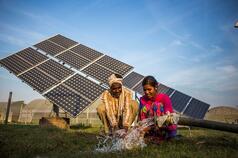
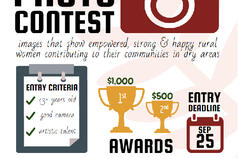
Rural women make up over a quarter of the total world population. In developing countries, rural women represent approximately 43 per cent of the agricultural labor force. Roughly forty percent of the world’s population lives in drylands, making dryland rural women farmers fundamental for the eradication of poverty, food security, and sustainable development. The International Day of Rural women on the 15th of October gives an opportunity to celebrate, support, and empower rural women farmers, including indigenous women.

The International Network for Bamboo and Rattan (INBAR) is the only global inter-governmental development organization committed to reducing poverty and protecting the environment through the use of bamboo and rattan. With headquarters in Beijing, China and offices in India, Ethiopia, Ghana and Ecuador, the INBAR Secretariat supports its 41 Member States worldwide and has links with a large number of international, regional, and national organizations.
The Technical Centre for Agricultural and Rural Cooperation ACP-EU (CTA), in collaboration with the African Development Bank (AfDB) and the support of partners including the Centre for Agricultural Bioscience International (CABI) and mLab East Africa, is launching the pilot edition of Pitch AgriHack, a new component of its AgriHack Talent
The position is to be filled at the earliest possible opportunity and has an initial contract term of 2 years. It is a part-time position (50%), implemented as a quota of 112 deployment days per year. There is an expectation of commitment beyond this quota, if required in acute emergency situations.
As an Expert Food & Nutrition Security (FNS) within the Humanitarian Assistance Team (HAT), you commit to being available for worldwide deployment, at the latest within 48 hours of an acute disaster/crisis situation or unforeseen assignment.
The Global Alliance for the Future of Food (GA) released a report, titled "Seeds of Resilience: A Compendium of Perspectives on Agricultural Biodiversity from Around the World." Led by the GA’s Agroecological Transitions Working Group (ATWG), the publication focuses on the role seeds and seed diversity can play in sustainable agriculture, food security, and nutrition.
Going on now in Stockholm, World Water Week in Stockholm is the annual focal point for the globe’s water issues. Almost 3500 scientists and water specialists are gathered in Stockholm 28 August – 2 September. IWMI scientists will be involved in 15 different events, two new initiatives will be launched and two upcoming IWMI/Routledge publications on water basins highlighted.
Read all about IWMI’s involvement here: www.iwmi.org/wwweek2016
To follow the event on social media: #WWWeek
Jeremy Bird, IWMI’s Director General, asks the question, “Can we produce even more food by intensifying our agricultural production, yet stay within the Earth's budget?”
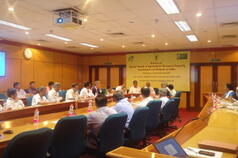
International Food Policy Research Institute (IFPRI) and National Academy of Agricultural Research Management (NAARM) organized a one day workshop on Recent Trends in Agricultural Research Capacity, Investment and Outputs in India on August 17, 2016 at the NASC Complex, PUSA, New Delhi.
Partner Spotlight: International Water Management Institute
New research throws light on why less and less spring water is making its way down the Himalayan ridges and valleys to the remote villages that depend on it the most.